
Tim[e]on of Athens
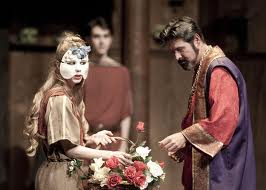
Timon of Athens – Shakespeare Tavern (January 2014)
Timon’s heart was gold. The only way he seemed to know how to express his good will was giving away money. He gave away money until he had nothing left. Then his friends, so-called, left him with nothing. He fled the city to live on whatever Mother Nature provided. As he burrowed into the earth for roots, She gave him gold–the last thing he wanted.
So, of course, all his friends, so-called, resurfaced.
He paid them off, paid them to go back to their lives and make worse misery than ever before. That shocked them, and they might’ve changed. But they didn’t. And Timon defied their pleas to rejoin them. Finally, he died, leaving his own epitaph above the grave.
Timon’s tragedy, from his own perspective, was that his goodness was his destruction. But I think perhaps his destruction was his good, and his tragedy was not recognizing it. He withered and imploded, never exploring the bigger picture his loss enabled.
The consummate loss of his objects, position, and dignity extracted him from the self-serving codified patterns of behavior that mask inner corruption and perversion. Because he had so long operated under the influence of those patterns, he was both perpetrator and prey of a hypnotic confirmation bias that blinded him to the inaccuracies and fragility of those constructed patterns. In short: the violent disruption of his life gave him a chance to see beyond the veil.
We humans pretend that we know what goodness is and what evil is. We imagine that those qualities are inherently connected to certain activities. Giving something away is generous, therefore good. Refusing to help somebody in need is selfish, therefore bad. And, the more dangerous corollary to this mode of thinking: we expect reciprocity, to the same degree and manner of the original action. Doing good means good will be done to you, etc.
What we fail to recognize is that our “inherent” understanding of good and evil were actually ideas that we came up with on our own after leaving behind the only actual embodiment of good / evil that exists: the One Person of God. As the ultimate being–omniscient, omnipresent, and omnipotent–He IS. Yes, He is…and by “is” I mean that He defines existence. Since He knows everything, He does not fail to calculate and determine accurately. Since He has always been there, is there now, and will always be there: His perspective overwhelms any others’. And even based on only those two qualities alone, He therefore has all power; He is the force with whom everyone/thing else has to do. He is irrevocable, and His actions alone qualify the components of good/evil.
Having severed ourselves from the only Source that could codify actual good/evil, we were left with mere masquerades–signifiers that were not wholly connected with the signified. And that little crack, that little fracture, exponentially multiplies into such division and chaos that we hardly know our Selves, whom we most cherish and wish to proj/tect.
Back to Athens.
They wore masks, the characters. The masks changed as the actors stepped in and out of multitudinous roles. They never came off: unless that person was being totally and completely honest and open with his fellow man. Which ultimately meant very few were ever bare-faced.
The bare-faced ones included Timon (the Rich Man), Appemantus (the Philosopher), Alcibiades (the Soldier), and Flavius (the Steward). These four argued among one another about the nature of goodness and its relationship to wealth. To the Rich Man, goodness-wealth was an external abundance of objects and pleasures to be mutually enjoyed and distributed among people as a bond of connection, projecting stability and therefore protecting against future disaster; surely, grateful recipients of monies and jewels would fortify a man against Fortune’s fancy? To the Philosopher, goodness-wealth was an internal knowledge of the world as it truly was, such that the knowledge-bearer would be spared the false enchantment of worldly constructs and be therefore free to engage with it solely on his own terms; but this superior perspective implies stupidity and baseness of those under the spell of this world, and who ever looks on the Other with affection? To the Soldier, goodness-wealth was the accumulation of discrete actions undertaken as an expression of loyalty and whose cumulative effect of reputation could outweigh any peculiar anomalies; who that was trained to violently express honor could not be pardoned for refusing to put up with society’s abuse, even in the flimsy form of sarcasm? To the Steward, goodness-wealth was the suture of whole-heartedness and disinterestedness, as demonstrated by applying every personal skill to the improvement of anOther’s personhood; but is such submission degrading or glorifying, to the recipient or the supplier?
Confusion and frustration result from the intense competition of these value systems (i.e. material generosity, abstract knowledge, personal honor, communal loyalty) and symbol systems (objects, speech, actions, measurements). And the stakes only grow higher as the Rich Man’s final emptiness exposes the deep-wrought expectations of each party. They all threaten each other. If the Rich Man gives too much of himself away, how can the balance of power be maintained? If the Philosopher makes us know too much of ourselves, how can we ever be comfortable in our own skins, with all our imperfections and play-making? If the Soldier violently enforces his code to the point of death, doesn’t that cut off any possibility of Playfulness, feigning, double-speak, innuendo, or artfulness that colors humanity as superior to the beasts? If the Steward lays himself so prostrate to his lord’s commands, does he not abdicate his responsibility to the general community to curb excess and maintain an even scale?
But what is the ultimate threat? The upsetting of the masks.
Once the ruse is up, once the nicely choreographed charade ceases to whirl in perpetual motion, it shatters into a thousand pieces.
It shatters because it is based on nothing.
Generosity may also be bribery. Knowledge may also be treachery. Honor may also be ignoble. Loyalty may also be obstinance. How do we discern the line? For there must be a line that divides good/evil, correct?
But rather than getting one without the other, good/evil are a single double-edged sword. And how can you know whether the sword will protect you or destroy you, save you or undo you, unless you know the Who that wields it? Unless you have relationship with the Who–is He your foe bent to kill you? Your surgeon to slice out sickness? Your fellow sportsman to play?
Timon discovered that if man wields the definition of good/evil, there is no solid ground. “I am sick of this false world!” he laments. And “what a beast art thou already,” he challenges the Philosopher; the whole earth, from soil to immortal spirit is perverted. His servant best expressed the most poignant lament: even if the Devil never cursed us, mankind would do far more on his own: “The devil knew not what he did when he made man politic; he crossed himself by ‘t: and I cannot think but, in the end, the villainies of man will set him clear.” Our own pursuit of power, power to care for our selves apart from the irrevocable Him, led us on a wild goose chase of wealth as our good. But our goodness-wealth is a shape-shifter that melts and morphs into evil-poverty at the turn of a dime. Our own goodness is no guarantee that our own life will remain in our safe keeping.
Because this self-constructed system fails so miserably to sustain human life, Timon’s answer is to kill everyone–including himself.
And ironically, so is His.
God killed Himself by becoming a man; we kill our Selves, the skin-bound part that ties us to this planet we corrupted. Following His empowering, substitutionary road, we shed our masks of carbon dust so that our spirits regain precedence. Then, new-won, like stars, we shine again with the reflected image of Life itself.
That sounds mystical and all…but I rather think it’s true.
 christopologie